Introduction
Content creation has always been one of the biggest bottlenecks in growing a website. For years, bloggers, marketers, and business owners relied on manual writing to produce high-quality content. It worked—but it was slow, inconsistent, and difficult to scale.
Now in 2026, everything has changed.
With the rise of AI-powered tools, especially WordPress AI writer plugins, content creation is faster, more scalable, and more accessible than ever. But this raises a critical question:
Is AI writing actually better than manual writing? Or does manual writing still have an advantage when it comes to SEO, quality, and long-term growth?
In this in-depth guide, we’ll compare WordPress AI writer plugins vs manual writing across every important factor—speed, SEO, scalability, quality, and real-world results—so you can decide which approach is best for your blog.
How Content Creation Has Changed in 2026
To understand this comparison, you need to understand how content creation has evolved.
In the past:
- Writing was manual
- Publishing was slow
- SEO required deep knowledge
- Scaling content was difficult
Today:
- AI generates content instantly
- SEO can be automated
- publishing is faster than ever
- scaling is possible for anyone
The shift is no longer about if you should use AI—it’s about how you use it.
What Is a WordPress AI Writer Plugin?
A WordPress AI writer plugin is a tool that integrates directly into your WordPress dashboard and allows you to generate blog content automatically.
Instead of writing everything yourself, you can:
- generate full blog posts
- create outlines and headings
- optimize for SEO
- save drafts instantly
- publish or schedule content
Everything happens inside WordPress, making it a complete workflow solution.
What Is Manual Writing?
Manual writing is the traditional approach where you:
- research a topic
- create an outline
- write content from scratch
- edit and optimize
- publish manually
This method gives you full control over your content, but it requires significantly more time and effort.
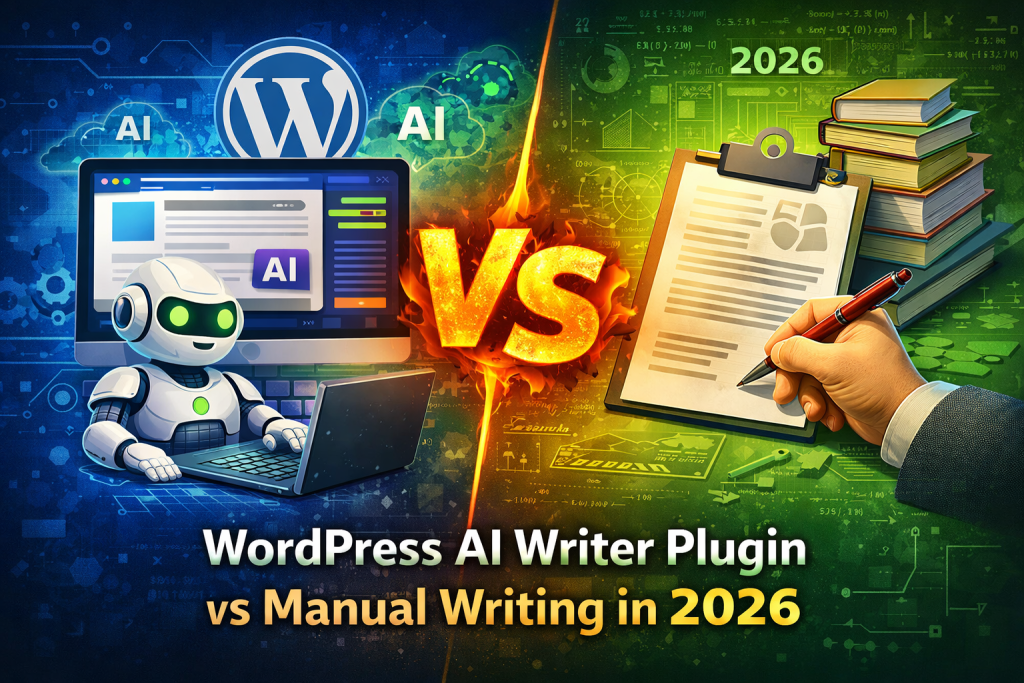
Core Difference: Speed vs Control
At its core, this comparison comes down to:
- AI writing = speed, automation, scalability
- Manual writing = control, creativity, depth
The best approach depends on your goals—but for SEO and growth, speed often wins.
Speed Comparison: AI vs Manual Writing
Speed is one of the biggest advantages of AI.
WordPress AI Writer Plugin:
- generate a full blog post in minutes
- no need to switch tools
- instant formatting and structure
Manual Writing:
- 1–3 hours per post (or more)
- requires research and editing
- slower publishing
Over time, this difference compounds dramatically.
If you publish:
- 1 post per day manually → ~30/month
- 5 posts per day with AI → 150/month
That’s a massive difference in growth potential.

SEO Performance: Which One Ranks Better?
SEO is where this comparison really matters.
AI Writing for SEO
A WordPress AI writer plugin can:
- structure content correctly
- place keywords naturally
- optimize headings
- generate meta descriptions
- support internal linking
This creates consistent SEO-friendly content.
Manual Writing for SEO
Manual writing can also rank—but it depends on:
- your SEO knowledge
- how well you optimize
- how consistent you are
Most people struggle with consistency, which limits results.
Content Quality: Does AI Lower Quality?
This is one of the biggest concerns people have.
The truth is:
👉 AI does not lower quality—bad usage does.
AI Writing Quality:
- structured and consistent
- can be high-quality with proper prompts
- scalable
Manual Writing Quality:
- highly customized
- potentially deeper insights
- more time-consuming
The best results come from combining both.
Scalability: The Biggest Advantage of AI
Scaling content is the key to SEO success.
With AI:
- generate dozens of posts per week
- target multiple keywords
- build content clusters
With Manual Writing:
- limited output
- slower growth
- harder to scale
In 2026, scalability is everything.
Consistency and Publishing Frequency
Consistency is one of the most important ranking factors.
Search engines reward websites that publish regularly.
AI Advantage:
- consistent posting schedule
- automated workflows
- no burnout
Manual Writing:
- inconsistent publishing
- risk of burnout
- slower output
Consistency alone can determine your success.
Keyword Targeting and Content Volume
To rank on Google, you need to target many keywords—not just one.
AI allows you to:
- target long-tail keywords
- create multiple variations
- build topic clusters
Manual writing makes this much harder.
Internal Linking and Site Structure
Internal linking improves SEO by connecting your content.
With AI plugins, you can:
- insert links efficiently
- build structured content networks
Manual writing requires:
- tracking links manually
- more effort as your blog grows
Cost Comparison
AI Writing:
- low cost per post
- high output
- scalable
Manual Writing:
- higher time investment
- potential outsourcing costs
- limited scalability
AI provides a better return on investment.
Real-World Example: Growth Comparison
Let’s compare two bloggers.
Blogger A (Manual Writing):
- 2 posts per week
- 8 posts per month
- slow growth
Blogger B (AI Writing):
- 5 posts per week
- 20+ posts per month
- faster growth
After 6 months:
- Blogger A: ~50 posts
- Blogger B: 120+ posts
👉 Who do you think gets more traffic?
Best Strategy: Combine AI + Manual Editing
The smartest approach is not choosing one—it’s combining both.
Workflow:
- Generate content with AI
- edit and refine manually
- optimize SEO
- publish
This gives you:
- speed
- quality
- scalability
Common Mistakes to Avoid
Avoid these mistakes:
- publishing without editing
- ignoring SEO
- overusing keywords
- low-quality content
- inconsistent posting
Even with AI, strategy matters.
Future of Blogging: AI + Human Collaboration
The future of blogging is not AI vs humans—it’s AI + humans.
AI handles:
- speed
- structure
- scalability
Humans handle:
- creativity
- refinement
- unique insights
This combination is unbeatable.
Final Verdict: Which Is Better?
If your goal is:
- scale content
- rank faster
- grow traffic
👉 WordPress AI writer plugins are better
If your goal is:
- deep storytelling
- creative writing
- full control
👉 manual writing still has value
But for SEO and growth in 2026, AI has the edge.
Conclusion
The debate between WordPress AI writer plugins vs manual writing is no longer about which one is better—it’s about how you use them.
AI gives you the ability to:
- create content faster
- scale your blog
- optimize SEO
Manual writing gives you:
- control
- creativity
- refinement
When combined, they create a powerful system for growth.
🚀 Ready to Start?
Stop writing blog posts manually.
Start generating SEO-optimized content directly inside WordPress:
👉 https://plixoratech.com/plixora-ai-blog-generator/
🏷️ 10 SEO TAGS (Comma-Separated)
wordpress ai writer plugin vs manual writing 2026, ai writing vs manual blogging seo comparison, wordpress ai content plugin vs human writing, ai blog generator vs manual writing pros and cons, seo content automation vs manual writing wordpress, ai writing tools for wordpress blogging 2026, manual writing vs ai content generation seo ranking, wordpress ai plugin for blog writing comparison, ai vs human content creation wordpress seo, plixora ai writer vs manual blogging