
Introduction
If you’re running a WordPress blog in 2026, you’ve probably realized something important: writing content is no longer the hardest part. Ranking it is. The competition is smarter, faster, and increasingly powered by AI. That’s why having a clear SEO content workflow for WordPress bloggers in 2026 is no longer optional—it’s the difference between getting traffic and getting ignored.
Search engines have evolved. They now prioritize structured, helpful, and consistently optimized content. At the same time, content creators are expected to publish faster than ever while maintaining quality. This creates a problem: how do you scale content without sacrificing SEO performance?
The answer lies in building a repeatable, optimized workflow—one that combines strategy, structure, and automation. In this guide, you’ll learn exactly how to create a high-performing SEO content workflow step-by-step, and how AI tools can dramatically simplify the entire process.
Why a Structured SEO Content Workflow Matters More Than Ever
The Shift in Content Creation
In the past, blogging was simple. You picked a topic, wrote an article, and hit publish. Today, that approach rarely works. Google evaluates content based on relevance, structure, engagement, and user intent. Without a structured workflow, your content becomes inconsistent, which directly impacts rankings.
A strong workflow ensures that every blog post you create follows proven SEO principles. Instead of guessing what works, you follow a system that increases your chances of ranking.
Consistency Is the Real Ranking Factor
One of the most overlooked aspects of SEO is consistency. It’s not just about one great blog post—it’s about producing optimized content regularly. A workflow removes decision fatigue and allows you to focus on execution.
When every post follows the same optimized process, you build momentum. Over time, this compounds into higher rankings, more traffic, and stronger authority in your niche.
Step 1: Keyword Research and Search Intent
Understanding What People Are Actually Searching For
Every effective SEO content workflow for WordPress bloggers in 2026 starts with keyword research. However, it’s not just about finding keywords—it’s about understanding intent.
Search intent answers the question: why is someone searching this? Are they looking for information, a solution, or a product? If your content doesn’t match that intent, it won’t rank—no matter how well written it is.
Choosing the Right Keywords
Instead of targeting highly competitive keywords, focus on:
- Long-tail keywords with clear intent
- Keywords with lower competition
- Topics where you can provide real value
This approach allows you to rank faster and build authority over time.
Step 2: Structuring Your Blog Post for SEO
The Importance of Content Structure
Once you have your keyword, the next step is structuring your content properly. Google prefers content that is easy to read, well-organized, and logically formatted.
A strong structure includes:
- A compelling introduction
- Clear H2 and H3 sections
- Logical flow between ideas
- A strong conclusion
This not only improves SEO but also keeps readers engaged.
Writing for Humans First, Then Search Engines
One common mistake bloggers make is over-optimizing for keywords. While keywords are important, readability matters more. Your content should feel natural, not forced.
The goal is to create content that answers questions clearly and keeps readers on the page longer. Engagement signals like time on page and bounce rate directly impact rankings.

Step 3: Creating High-Quality Content at Scale
The Biggest Challenge: Time
Writing high-quality blog posts consistently is one of the biggest challenges for WordPress bloggers. A single optimized post can take hours—or even days—to complete.
This is where most people fail. They either burn out or stop publishing consistently.
How AI Changes the Game
AI tools have completely transformed content creation. Instead of starting from scratch, you can now generate structured, SEO-optimized drafts instantly.
However, the real advantage isn’t just speed—it’s consistency. AI ensures that every post follows best practices, reducing human error and improving efficiency.
Step 4: On-Page SEO Optimization
What Actually Impacts Rankings
On-page SEO is where many bloggers lose rankings without realizing it. Even great content can fail if it’s not properly optimized.
Key elements include:
- Title optimization with your main keyword
- Meta descriptions that improve click-through rate
- Proper heading structure
- Internal linking
- Image optimization
Each of these signals helps search engines understand your content better.
Automating SEO Optimization
Manually optimizing every element can be time-consuming. This is why automation is becoming essential in modern workflows.
Instead of handling each step separately, AI tools can generate SEO titles, descriptions, tags, and structure automatically—saving time while improving accuracy.
Step 5: Publishing and Consistency Strategy
Frequency Matters More Than Perfection
One of the biggest misconceptions in blogging is that every post needs to be perfect. In reality, consistency beats perfection every time.
Publishing regularly signals to Google that your site is active and relevant. This increases your chances of being crawled and indexed more frequently.
Building Momentum Over Time
The first few posts might not bring much traffic. That’s normal. SEO is a long-term game. However, as your content library grows, your chances of ranking increase significantly.
Each new post becomes another entry point for traffic, creating a compounding effect.
Step 6: Analytics and Continuous Improvement
Tracking What Works
A strong SEO content workflow doesn’t end after publishing. You need to analyze performance and adjust your strategy.
Look at:
- Which posts are ranking
- Which keywords are driving traffic
- Which pages have high bounce rates
This data helps you refine your approach and improve future content.
Updating Existing Content
One of the most effective SEO strategies is updating old posts. Instead of always creating new content, you can improve existing articles to boost rankings.
This includes:
- Adding new information
- Improving structure
- Updating keywords
Over time, this keeps your content relevant and competitive.
Common Mistakes WordPress Bloggers Make
Writing Without a Strategy
Many bloggers jump straight into writing without doing keyword research or planning structure. This leads to content that doesn’t rank.
Ignoring SEO Fundamentals
Even in 2026, basic SEO principles still matter. Skipping optimization steps can prevent your content from performing.
Not Using Automation
Trying to do everything manually is inefficient. Modern blogging requires leveraging tools that streamline your workflow.
Manual Workflow vs AI-Powered Workflow
Manual Workflow
A traditional workflow involves multiple tools and a lot of manual effort. You research keywords, write content, optimize SEO, and format everything yourself.
While this can work, it’s slow and difficult to scale.
AI-Powered Workflow
An AI-powered workflow simplifies everything into a single process. You can generate content, optimize SEO, and publish faster—all while maintaining quality.
This is the direction content creation is moving toward, and those who adopt it early gain a major advantage.
How to Build the Perfect SEO Content Workflow
Step-by-Step Strategy
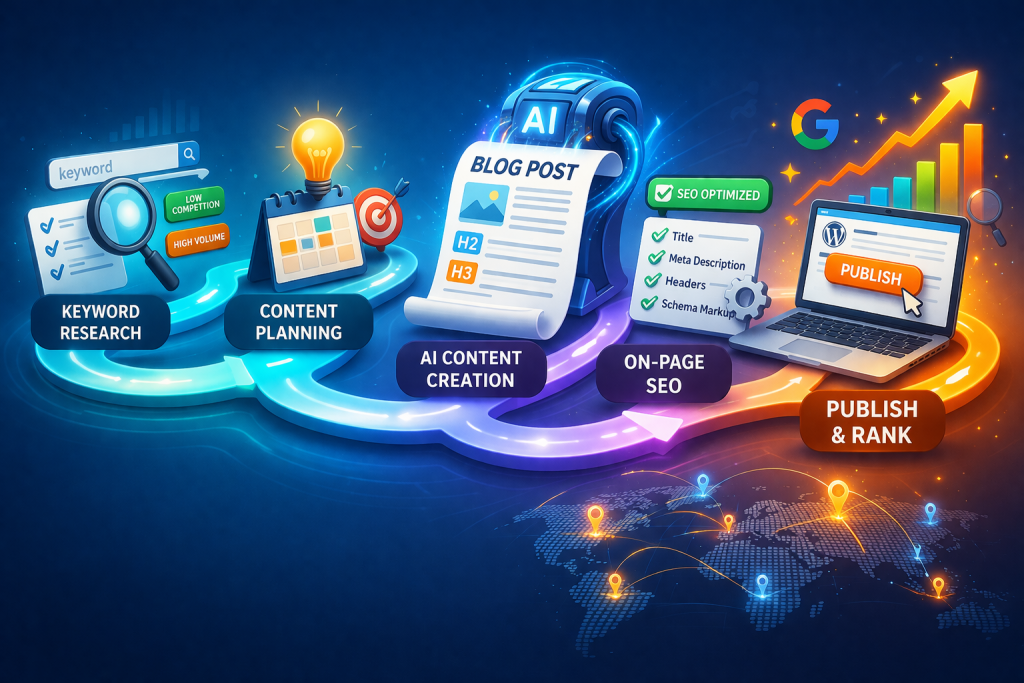
To build an effective workflow, focus on:
- Researching keywords with clear intent
- Structuring your content properly
- Creating high-quality drafts efficiently
- Optimizing for SEO
- Publishing consistently
- Analyzing and improving
When these steps are combined into a system, content creation becomes predictable and scalable.
Why AI Tools Are Essential in 2026
The Competitive Advantage
With more bloggers using AI, those who don’t adopt it risk falling behind. AI allows you to produce more content in less time while maintaining quality.
Saving Time Without Losing Quality
Instead of spending hours on each post, you can focus on strategy and growth. AI handles the repetitive tasks, freeing you to scale your content efforts.
Conclusion
Building the best SEO content workflow for WordPress bloggers in 2026 is all about efficiency, consistency, and optimization. The days of random blog posts are over. Success now comes from following a structured system that ensures every piece of content is designed to rank.
By combining keyword research, strong content structure, on-page SEO, and consistent publishing, you create a foundation for long-term growth. When you add AI into that workflow, everything becomes faster, easier, and more scalable.
The bloggers who win in 2026 aren’t necessarily the best writers—they’re the ones with the best systems.
Start Scaling Your SEO Content Today
If you want to simplify your workflow and start ranking faster, it’s time to use a tool designed specifically for WordPress bloggers.
👉 https://plixoratech.com/plixora-ai-blog-generator/
With this plugin, you can generate SEO-optimized blog posts, create content faster, and automate the most time-consuming parts of blogging—all directly inside WordPress.
Instead of struggling with content creation, you can focus on growing your traffic and scaling your site.