Introduction
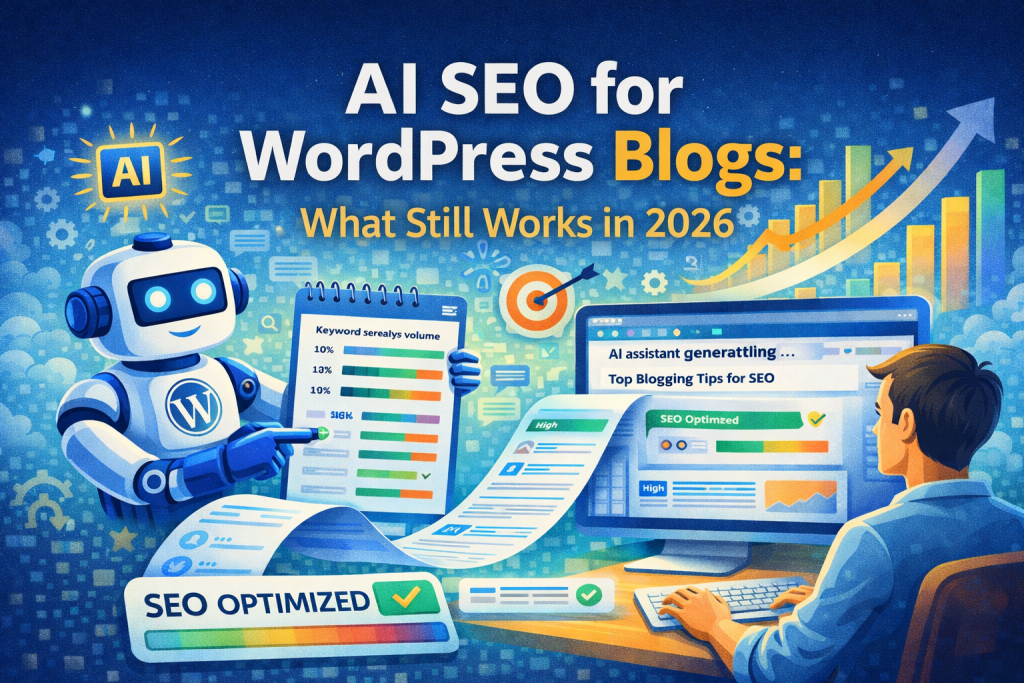
Search engine optimization has changed dramatically over the past few years, and in 2026, the landscape looks very different from what most bloggers were used to. Algorithms are smarter, competition is higher, and content is being produced at a scale that would have been impossible just a few years ago. This is exactly why understanding AI SEO for WordPress blogs: what still works in 2026 is critical if you want to grow traffic and stay competitive.
Many bloggers assume that AI has made SEO easier. In reality, it has made it more complex. While AI tools can generate content faster than ever, they have also raised the standard for quality, structure, and relevance. Simply publishing more content is no longer enough. You need a system that combines AI efficiency with proven SEO fundamentals.
In this guide, you’ll learn what still works in AI SEO for WordPress blogs, what has changed, and how to build a strategy that actually drives results in 2026.
The Evolution of SEO in the AI Era
From Keywords to Context
In the past, SEO was heavily focused on keywords. Bloggers would repeat phrases multiple times in an attempt to rank higher. While keywords are still important, search engines now prioritize context and intent.
Google understands topics, not just words. This means your content needs to fully answer a question rather than simply include a keyword. AI-generated content can help with this, but only if it is structured properly.
The Rise of AI Content
AI tools have transformed content creation. Bloggers can now generate full-length articles in minutes. However, this has also led to an explosion of low-quality content.
Search engines have adapted. They now reward content that is helpful, structured, and engaging. AI is not the problem—poor implementation is.
What Still Works in AI SEO for WordPress Blogs
High-Quality, Helpful Content
No matter how advanced AI becomes, one principle remains unchanged: content must provide value. If your blog post does not solve a problem or answer a question clearly, it will struggle to rank.
AI can help you create content faster, but it should always be guided by a clear purpose. The goal is not just to publish content, but to publish content that people actually find useful.
Strong Content Structure
Structure is one of the most underrated SEO factors. Well-organized content is easier for both users and search engines to understand.
Using clear headings, logical sections, and smooth transitions improves readability and engagement. This directly impacts rankings.
Search Intent Alignment
Understanding why someone is searching is more important than ever. If your content does not match search intent, it will not perform well.
For example, if someone searches for a guide, they expect a detailed explanation. If they are looking for a comparison, they want clear differences. Matching this intent is essential.
What No Longer Works in 2026
Keyword Stuffing
Repeating the same keyword over and over is outdated. It not only hurts readability but can also negatively impact rankings.
Instead, focus on natural language and topic coverage.
Thin Content
Short, low-value articles are no longer effective. Search engines prioritize depth and quality.
This means your content should fully explore a topic rather than skim the surface.
Publishing Without Strategy
Random posting is one of the biggest mistakes bloggers still make. Without a clear plan, your content lacks direction and authority.
How AI Enhances SEO Instead of Replacing It
AI as a Tool, Not a Shortcut
AI should be seen as an assistant, not a replacement. It helps you work faster, but strategy still matters.
When used correctly, AI can improve consistency, structure, and efficiency.
Scaling Content Without Losing Quality
One of the biggest advantages of AI is scalability. You can produce more content in less time. However, maintaining quality is key.
This is where a structured workflow becomes essential.
Building an Effective AI SEO Workflow for WordPress
Step 1: Keyword and Topic Research
Everything starts with understanding what your audience is searching for. This allows you to create content that meets real demand.
Step 2: Content Planning
Organizing your ideas into a clear structure ensures that your content is focused and easy to follow.
Step 3: AI Content Generation
AI tools can generate drafts quickly, allowing you to focus on refining and improving the content.
Step 4: SEO Optimization
Optimizing titles, headings, and internal links ensures that your content is search-engine friendly.
Step 5: Publishing and Monitoring
Once your content is live, tracking performance helps you refine your strategy over time.
AI SEO vs Traditional SEO
Traditional SEO Approach
Traditional SEO relies heavily on manual processes. While effective, it can be time-consuming and difficult to scale.
AI-Powered SEO Approach
AI-powered SEO combines automation with strategy. It allows you to produce more content while maintaining consistency.
This approach is becoming the standard in 2026.
Common Mistakes in AI SEO for WordPress Blogs
Over-Reliance on AI
Using AI without oversight can lead to generic content. Always review and refine what AI generates.
Ignoring User Experience
SEO is not just about search engines. It’s about users. If your content is hard to read or not engaging, it will not perform well.
Lack of Consistency
Publishing inconsistently makes it harder to build authority. A regular schedule is essential.
Advanced Strategies That Still Work in 2026
Topic Clusters
Grouping related content together improves SEO performance. This helps search engines understand your site’s authority.
Internal Linking
Linking your posts together creates a stronger structure and improves navigation.
Content Updates
Updating old content is one of the most effective ways to improve rankings.
How to Stay Ahead in AI SEO
Focus on Value
No matter how technology evolves, providing value will always be the foundation of SEO.
Adapt to Changes
SEO is constantly evolving. Staying informed and adjusting your strategy is key.
Use the Right Tools
The tools you use can significantly impact your results. Choosing the right AI solutions can give you a competitive edge.
Conclusion
Understanding AI SEO for WordPress blogs: what still works in 2026 is about combining modern tools with timeless principles. While AI has changed how content is created, it has not changed what makes content successful.
By focusing on quality, structure, and strategy, you can build a blog that ranks consistently and drives long-term traffic. AI simply makes this process faster and more efficient.
The bloggers who succeed are not the ones who rely solely on AI, but the ones who use it strategically.
Start Scaling Your SEO with AI Today
If you want to simplify your workflow and stay competitive in 2026, it’s time to use a tool built for modern WordPress bloggers.
👉 https://plixoratech.com/plixora-ai-blog-generator/
With this plugin, you can generate SEO-optimized content, improve your workflow, and scale your blog faster than ever.
Stop guessing what works—and start building a system that drives real results.
🏷️ SEO TAGS: AI SEO WordPress 2026, WordPress SEO strategies, AI content optimization, blogging with AI tools, SEO workflow WordPress, AI blog generator SEO, content marketing strategy 2026, increase blog traffic AI, WordPress ranking tips, AI SEO best practices